A cryptocurrency online casino is an online gambling site that lets you deposit, bet and withdraw using digital currencies such as Bitcoin, Ethereum or a stablecoin like Tether, instead of New Zealand dollars moving through a bank or card. The games themselves are the usual mix of pokies, table games and live dealer tables; what changes is the money rail underneath them. This page explains how crypto payments and crypto gambling actually work — deposits, network confirmations, fees, price volatility, security and the New Zealand legal position in 2026. It is background information, not a recommendation or a review, and it contains no sign-up offers or bonus codes.
Key Points
- A cryptocurrency online casino accepts digital currencies (Bitcoin, Ethereum, stablecoins) for deposits, bets and withdrawals instead of New Zealand dollars through a bank or card.
- Deposits are sent to a wallet address and confirmed by the blockchain network, not a bank; transfers are irreversible and carry a network fee.
- Cashing out is a two-step process: the casino releases coins, then you sell them on an exchange to get NZ dollars.
- Price volatility is a separate risk from the games; stablecoins avoid it, Bitcoin and Ethereum do not.
- “Provably fair” verifies some in-house games but does not change the house edge or guarantee payment, and crypto play is pseudonymous, not anonymous.
- In New Zealand, legality depends on licensing under the Online Casino Gambling Act 2026, not on the payment method; advertising to New Zealanders is prohibited.
What is a cryptocurrency online casino?
A cryptocurrency online casino is a gambling platform that accepts one or more cryptocurrencies as a payment method. “Cryptocurrency” means digital money recorded on a blockchain — a shared public ledger maintained by a network of computers rather than a single bank. Instead of a card number or a bank login, you move value between wallet addresses, and the network records each transfer.
There are two broad types. Some sites are “crypto-first”: they were built around digital currency, often hold player balances in crypto, and may offer in-house games that advertise a “provably fair” check (explained below). Others are mainstream casinos that simply add crypto alongside cards and e-wallets, converting your deposit into a currency balance behind the scenes. Knowing which type you are looking at matters, because it changes how volatility, fees and withdrawals behave.
How crypto payments work at an online casino
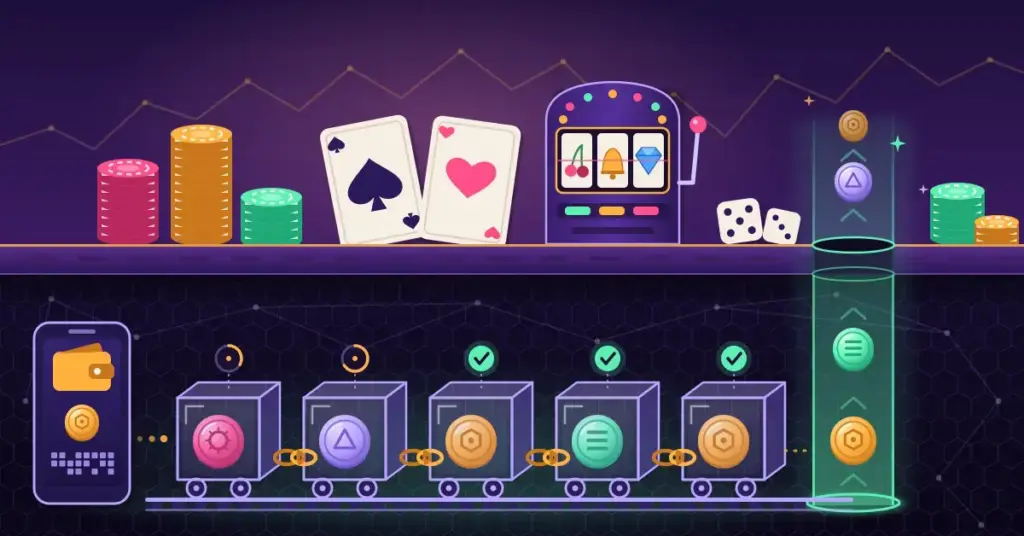
Crypto payments work by sending coins from your own wallet to an address the casino generates for you, with the blockchain network — not a bank — confirming the transfer. The three stages a player meets are the deposit, the network confirmation, and the withdrawal.
Making a deposit
When you choose to deposit in crypto, the casino shows a unique deposit address (a long string of characters) and usually a QR code. You open your own wallet — an app, a browser extension or a hardware device — paste or scan that address, enter the amount and send. Two details cause most problems for beginners:
- The address must match the currency and network exactly. Bitcoin goes to a Bitcoin address, Ethereum to an Ethereum address. Sending the wrong coin, or the right coin on the wrong network, can lose the funds permanently.
- Transfers are irreversible. There is no “charge back” on a blockchain. Once a transaction is confirmed, only the receiver can send it back.
Confirmations, fees and timing
After you send a deposit, the network must confirm it before the casino credits your balance. A “confirmation” is the network recording your transaction in a block and then building more blocks on top; most casinos wait for one to several confirmations as a safeguard. In practice a deposit can clear in a few minutes on a fast chain, or take longer on Bitcoin when the network is busy.
Every on-chain transfer also carries a network fee (sometimes called gas) that goes to the network, not the casino. These fees change constantly with demand. Litecoin and stablecoins sent on low-cost networks are usually cents; Ethereum fees can spike when the chain is congested. Some casinos absorb the fee, others pass it to you — the only way to know is the cashier page.
Withdrawals and cashing out
You can cash out crypto for real money, but almost never in one step at the casino itself. A withdrawal sends coins back to your wallet address; to turn those coins into New Zealand dollars you then sell them on a cryptocurrency exchange and transfer the proceeds to your bank. So “fast crypto payout” usually describes how quickly the casino releases the coins, not how quickly cash reaches your account. If you prefer money to land straight in a bank account, our guide to withdrawing money from an online casino covers the non-crypto routes, and the page on PayPal casino alternatives in New Zealand explains the e-wallet options.
Which cryptocurrencies do online casinos accept?
The currencies you will see most often are Bitcoin (BTC), Ethereum (ETH), Litecoin (LTC) and the stablecoins Tether (USDT) and USD Coin (USDC). They behave very differently on the three things a gambler cares about: how fast a deposit clears, how much the network fee costs, and how much the value can swing while you hold it. The table below summarises typical behaviour; exact times and fees change constantly with network traffic, so treat them as general patterns rather than fixed figures.
Cryptocurrency Comparison
| Cryptocurrency | Common network | Typical deposit speed | Typical network fee | Price volatility |
|---|---|---|---|---|
| Bitcoin (BTC) | Bitcoin blockchain | Minutes to an hour (1–3 confirmations) | Variable; can be high when the network is busy | High |
| Ethereum (ETH) | Ethereum blockchain | A few minutes | Variable “gas” fee; can spike sharply | High |
| Litecoin (LTC) | Litecoin blockchain | A few minutes | Usually very low (cents) | High |
| Tether (USDT) | Tron or Ethereum (networks differ) | Minutes | Low on Tron; higher on Ethereum | Low (tracks the US dollar) |
| USD Coin (USDC) | Ethereum and other chains | Minutes | Varies by network | Low (tracks the US dollar) |
Stablecoins and why they matter
A stablecoin is a cryptocurrency designed to track the value of a traditional currency — USDT and USDC both aim to stay at about one US dollar. Because the price barely moves, a stablecoin removes the biggest surprise of crypto gambling: your balance does not quietly gain or lose value between deposit and withdrawal the way Bitcoin can. The trade-off is that a stablecoin can be sent on several different networks (for example USDT on the Tron network versus the Ethereum network), and these are not interchangeable — sending on a network the casino does not support is a common way to lose a deposit.
Volatility: the hidden variable in crypto gambling
Price volatility means the value of most cryptocurrencies can rise or fall sharply over hours or days, and that affects your gambling balance separately from whether you win or lose at the games. Suppose you deposit crypto worth NZ$200, play to a balance worth NZ$220, but the coin’s market price drops 10% before you withdraw — the coins you cash out may be worth close to what you started with, even though you “won” at the table. The reverse can also happen. Either way, a volatile coin adds a second bet you did not choose: a bet on the exchange rate.
This is why many players who use crypto for payments prefer stablecoins for the balance they are not actively playing, and why the question “did I win?” at a crypto casino has two answers: the game result, and the currency movement.
Is a crypto casino safe? Security and “provably fair” explained
A crypto casino is only as safe as the operator behind it, its licence and your own wallet security — the blockchain secures the transfer, not the gambling. The payment rail is robust, but it offers no consumer protection: because transactions are irreversible and the casino may hold your balance, a site that refuses to pay, or disappears, is far harder to challenge than a card dispute. The key safety checks are the operator’s licensing, its ownership, its published terms, and whether you control your own wallet.
What “provably fair” does and does not prove
“Provably fair” is a cryptographic feature on some in-house crypto games that lets you verify a specific round was not altered after you bet. It works by committing to a hidden server value before the round and revealing it afterwards, so you can check the result was pre-set, not rigged in the moment. It is a genuine transparency tool, but it has limits: it usually covers only certain in-house titles, not the licensed pokies and live tables from major studios; it does not change the house edge; and it does not prove the casino will pay you. Treat it as one honest signal, not a guarantee of fairness or solvency.
KYC and the anonymity myth
Crypto casinos are often marketed as anonymous, but that is only partly true. KYC (“know your customer”) is the identity check regulated operators must run — proof of name, age and address. Many crypto sites let you deposit and play without it, then require full KYC before a withdrawal, especially a large one or where anti-money-laundering rules apply. Blockchains are also public: transactions are pseudonymous, not secret, and can often be traced back to an exchange account that is linked to your real identity. Assume your activity is recordable, not invisible.
If you want to see how these checks and payment options play out on specific crypto-accepting brands, the neutral profiles of BitStarz, Bitcasino and Brango Casino each set out the operator, licence and crypto banking details for that site.
Crypto casinos and New Zealand law in 2026
In New Zealand, using crypto does not change the legal status of an online casino — the law looks at who is licensed to offer gambling to New Zealanders, not at the payment method. Under the Online Casino Gambling Act 2026, which came into force on 1 May 2026, the Department of Internal Affairs (DIA) is building a licensed regime for online casino gambling, and advertising online casino gambling to New Zealand customers is prohibited. That advertising ban is the direct reason reputable New Zealand sites do not publish ranked “best crypto casino” lists or bonus codes.
The DIA ran a licence auction from 29 September to 12 October 2026, after which 11 entities won the right to apply for up to 15 available licences. From 1 December 2026, providers that have not applied for a licence are required to stop offering online casino gambling in New Zealand, and the fully licensed regime is not expected to be operational until 2027. Until a casino holds a New Zealand licence, it is an offshore operator regardless of whether it also holds a licence from Malta, Curaçao or elsewhere — and overseas licences are not the same as New Zealand legality. Operator and ownership details change often, so treat any single licence claim with caution and verify it against the regulator.
Is crypto gambling taxed in New Zealand?
There are two separate tax questions, and only a tax professional can apply them to your situation. First, casual gambling winnings are generally not taxed in New Zealand because gambling is not treated as a taxable activity for a recreational player. Second, and this is the part crypto adds, Inland Revenue treats cryptoassets as a form of property: in most cases the amounts you get from selling, trading or exchanging cryptoassets can be taxable, which includes exchanging one cryptoasset for another. Whether such a gain is taxable depends on why you acquired the coins: if you got them for the purpose of selling or exchanging them, you pay income tax on any profit, and Inland Revenue looks at your main purpose at the time you acquire them rather than how long you hold them. In plain terms, winning at a game and later selling the crypto for a higher dollar value are different events. Keep records of what you deposited, won and withdrew, and check Inland Revenue’s cryptoasset guidance or an accountant rather than assuming it is all tax-free.
Common mistakes with crypto at casinos
Two habits cause avoidable losses that have nothing to do with the games:
- Not sending a test amount first. If you are not certain you have the right address and network, send a small test transfer before the full deposit — a confirmed test costs cents and a lost deposit is gone for good.
- Chasing losses because “it’s only crypto”. A digital balance is still real money; the risk is identical to depositing dollars.
Crypto versus traditional casino payments
Crypto’s advantages over cards and bank transfers are speed on the casino’s side, low fees on some networks, and the option to keep a bank account uninvolved. Its disadvantages are price volatility, irreversible transfers with no chargeback, the extra step of an exchange to reach dollars, and weaker consumer recourse if something goes wrong. Traditional methods — debit cards, bank transfers and e-wallets — are slower to leave and may show on a statement, but they are stable in value, reversible in some cases, and backed by established dispute processes. Neither is “better” in the abstract; they suit different priorities.
Responsible gambling and support
Crypto can make gambling feel frictionless — fast deposits, a balance that does not look like your bank account, and the sense that it is “just coins”. That friction normally helps people pause, so it is worth setting your own limits before you play and treating a crypto balance as the real money it is. This page is background information only and is not financial, legal or gambling advice, and it is not a recommendation to sign up anywhere.
If gambling is causing harm to you or someone you know in New Zealand, free, confidential, 24/7 help is available from the responsible gambling support services: call the Gambling Helpline on 0800 654 655, text 8006, or visit safergambling.org.nz. You must be 18 or over to gamble.
Sources
- Department of Internal Affairs — Online casino gambling licensing timeline
- Department of Internal Affairs — Online casino gambling Q&A (verify age, at least 18)
- Inland Revenue — Cryptoassets and tax
- Inland Revenue — Buying and selling cryptoassets
- Inland Revenue — Acquiring cryptoassets to sell or exchange
- Inland Revenue — Taxing prize money (gambling and lottery winnings)
- Malta Gaming Authority
- Gambling Helpline Aotearoa New Zealand
Frequently asked questions (FAQ)
Is a crypto casino safe?
The blockchain makes the payment itself secure and hard to tamper with, but it offers no consumer protection, so the real safety depends on the operator’s licence, ownership and track record, plus your own wallet security. Because transfers are irreversible and many sites hold your balance, a dishonest or failing casino is harder to challenge than a card payment.
Can you cash out crypto for real money?
Yes, but usually in two steps. The casino sends your winnings as crypto to your wallet, and you then sell those coins on a cryptocurrency exchange and transfer New Zealand dollars to your bank. A “fast crypto payout” describes how quickly the coins are released, not how quickly spendable cash reaches your account.
Does using cryptocurrency improve my chances of winning?
No. Each game’s result is set by its return-to-player percentage and random number generator, which do not depend on how you paid. Crypto only changes the payment rail; it does not change the house edge. If a coin’s price moves while you hold it, that is a separate currency gain or loss, not better odds.
Are crypto online casinos legal in New Zealand in 2026?
Legality depends on licensing, not on the payment method. Under the Online Casino Gambling Act 2026 the Department of Internal Affairs is licensing operators, advertising online casino gambling to New Zealanders is prohibited, and the fully licensed regime is not expected to be operational until 2027. An overseas licence from Malta or Curaçao does not make a site licensed for the New Zealand market.
Which cryptocurrency is best for casino payments?
There is no single best coin; it depends on what you value. Stablecoins such as USDT or USDC avoid price volatility, Litecoin is usually cheap and quick to send, and Bitcoin is the most widely accepted but can be slower and dearer when its network is busy. Always send on the exact network the casino’s cashier specifies.