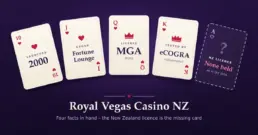

Royal Vegas Casino is one of the longest-running online gambling brands aimed at international players, launched in 2000 as part of the Fortune Lounge Group. This guide explains who operates it, how its games and banking work, what its licences and independent testing actually mean, and — most importantly for Kiwi readers — where the casino stands under New Zealand’s new online casino law. It is written as a neutral reference, not a promotion: nothing here is advice to sign up, deposit or play, and no claim is made that any game, bonus or strategy improves your chance of winning.
Quick Facts
| Brand | Royal Vegas Casino |
|---|---|
| Launched | 2000 |
| Group | Fortune Lounge Group |
| Reported licence holder | Baytree Limited (affiliate programme: Buffalo Partners) |
| Licensing | Malta Gaming Authority (MGA); also associated with Alderney |
| Game software | Games Global (formerly Microgaming), plus providers such as Evolution and NetEnt |
| Live dealer provider | Evolution |
| Independent testing | eCOGRA |
| NZ (DIA) licence | None held |
| Status for NZ players (2026) | Not licensed under the Online Casino Gambling Act 2026 |
What is Royal Vegas Casino?
Royal Vegas Casino is an offshore online casino that has operated since 2000 and targets a global audience, including players who search for it from New Zealand. It belongs to the Fortune Lounge Group, a long-established network of Microgaming-powered casino brands that also includes names such as All Slots, 7 Sultans and Platinum Play. The site offers pokies (online slot machines), table games, video poker and live dealer games through a browser and on mobile.
Being a veteran brand is not the same as being locally licensed. Royal Vegas is registered and licensed overseas, not in New Zealand, and its longevity tells you it has a track record — it does not tell you whether it is legal to advertise to, or aimed at, New Zealand residents in 2026. Those are separate questions, and the sections below keep them separate.
Who operates Royal Vegas and is it licensed?
Royal Vegas is operated within the Fortune Lounge Group; independent casino databases report the licence holder as Baytree Limited, with the Buffalo Partners programme handling its affiliate marketing. This is a corporate structure typical of long-standing Microgaming brands, where a Malta-registered company holds the gaming licence and a separate marketing arm promotes the sites.
Which gambling licences does Royal Vegas hold?
Royal Vegas states that it is licensed by the Malta Gaming Authority (MGA), and listings also associate the brand with Alderney. The MGA is one of Europe’s most established gambling regulators: a Malta licence sets rules on player fund protection, anti-money-laundering checks, game fairness and complaint handling, and the regulator can fine or suspend operators that break them. These are meaningful protections for players in markets the licence covers.
The key limitation for Kiwis is jurisdiction. A Malta or Alderney licence does not authorise a casino to serve New Zealand under New Zealand law. If a dispute arises, a Malta regulator’s powers help players in the markets Malta covers — it is not a New Zealand consumer-protection body. If you want to understand how to judge any operator’s safety signals, our guide on whether online casinos are safe explains licensing, encryption and fair-game testing in plain terms.
What does eCOGRA certification mean?
eCOGRA is an independent testing agency that audits online casino games and operations. An eCOGRA seal indicates that the casino’s random number generator (the software that decides each spin or deal) has been tested for randomness and that payout percentages are reported and reviewed. It is a credibility signal, not a guarantee of winnings: testing confirms that games behave as advertised over large samples, but the house edge still means the casino is expected to profit over time. Royal Vegas lists eCOGRA among its certifications.
Is Royal Vegas legal for New Zealand players in 2026?
Royal Vegas is not licensed in New Zealand, and that now matters because the law has changed. New Zealand passed the Online Casino Gambling Act 2026, which received Royal Assent on 27 April 2026 and took effect on 1 May 2026. For the first time, online casino gambling is being brought under a domestic licensing regime run by the Department of Internal Affairs (DIA), with the Gambling Commission hearing appeals.
The headline points of the new regime are:
- A capped market. The DIA will issue up to 15 online casino licences through a competitive auction, and no single party may control more than three.
- Advertising limits from 1 May 2026. Only New Zealand-licensed operators may advertise online casino gambling to New Zealanders, and affiliate marketing of online casinos is prohibited outright. This is the main legal reason reputable New Zealand sites no longer publish ranked bonus lists or operator promotions.
- A transition deadline. From 1 December 2026, offshore operators that have not lodged a licence application must stop offering online casino gambling to New Zealand residents. Operators with a pending application have until 1 July 2027 to either be licensed or exit.
- Real penalties. Breaches such as unlawful advertising or operating without a licence can attract fines of up to NZ$5 million for a company and NZ$300,000 for an individual.
- Extraterritorial reach. The Act is designed to apply to operators targeting New Zealanders from offshore, not only to companies based in the country.
Where does this leave Royal Vegas? As an offshore, non-DIA-licensed brand, it is not part of New Zealand’s regulated market. Enforcement under the Act is aimed at operators and advertisers rather than individual players, but the practical reality is that an unlicensed site is outside New Zealand’s consumer-protection and dispute framework. For the fuller legal background, see our explainers on the New Zealand Gambling Act 2003 and the NZ Gambling Commission.
Games at Royal Vegas Casino
Royal Vegas built its catalogue on Microgaming software and has reported several hundred titles across pokies, table games, video poker and live dealer games; game counts quoted by the brand and by review sites vary widely (from a few hundred to well over 700) and change as titles are added or retired. The important context is the software story behind those games.
Who makes the games now — Microgaming or Games Global?
The pokies many players associate with Microgaming are now distributed by Games Global. In 2022, Microgaming sold its online games portfolio and distribution business to Games Global Limited, a separately owned company. Microgaming-era titles such as Mega Moolah and Thunderstruck II therefore now sit under the Games Global library, while Microgaming itself focuses on platform and compliance systems. An older article that still calls these games “Microgaming” is not wrong about their origin, but Games Global is the current rights holder.
Pokies and progressive jackpots
The slot range runs from classic three-reel machines to modern video pokies with bonus features. Progressive jackpot titles — where a small slice of every bet across a network feeds a shared prize pool — are a long-standing draw at Microgaming/Games Global casinos, with Mega Moolah being the best known. Progressive jackpots can reach very large sums, but the odds of triggering one are extremely long; they are a high-variance form of play, not a realistic income plan. If you are new to the format, our beginner guide to how to play pokies explains RTP, volatility and paylines.
Table games and video poker
Royal Vegas offers multiple versions of blackjack, roulette, baccarat and casino poker, alongside video poker variants such as Jacks or Better, Deuces Wild and Aces and Faces. Table games and video poker generally have a lower house edge than slots when played to optimal strategy, but they also contribute far less toward bonus wagering requirements, which is an important distinction covered below.
Live dealer games
The live casino section streams real dealers in real time and has used Evolution, the market-leading live-studio provider. Live blackjack, roulette and baccarat run alongside game-show-style formats. Our page on how live casino games work explains the studio-streaming model and the main providers in more detail.
Bonuses and wagering requirements explained
Royal Vegas has historically run a multi-part welcome bonus that matches a percentage of your first several deposits up to a capped amount, together with loyalty points. Specific figures — match percentages, maximum amounts, the number of deposits and the exact wagering multiplier — change frequently and differ by region, so any single number you read online can be out of date within weeks. Because of this, and because the 2026 Act stops unlicensed offshore operators from advertising such offers to New Zealanders, this guide explains how these bonuses work rather than quoting a current promotion.
How a deposit-match welcome bonus works
A deposit-match bonus gives you extra bonus funds equal to a set percentage of what you deposit, up to a cap. A “100% match up to NZ$300” means a NZ$300 deposit is matched with NZ$300 in bonus money. Multi-tier packages simply repeat this across your first few deposits. The money is usually credited as restricted bonus funds that you cannot withdraw until conditions are met. Our broader casino bonus guide breaks down the main bonus types and their terms.
What a wagering requirement actually means
A wagering requirement (also called playthrough) is the number of times you must bet the bonus before any winnings become withdrawable. Royal Vegas has advertised wagering around 70x in some offers, which is high. A 70x requirement on a NZ$300 bonus means NZ$21,000 in total bets before a cash-out is allowed. Crucially, games contribute at different rates:
- Pokies: usually count 100% toward the requirement.
- Table games: blackjack, roulette and similar often count only a small fraction (sometimes around 5–10%), or are excluded entirely.
- Live dealer games: frequently contribute little or nothing.
High wagering multipliers are the single biggest reason players fail to withdraw bonus winnings. Always read the specific terms — game contribution, time limits, maximum bet while wagering and any maximum cash-out — before opting in. Our detailed guide to wagering requirements works through the maths with examples.
Banking: deposits and withdrawals
Royal Vegas has supported a standard mix of payment methods for international players: major credit and debit cards (Visa, Mastercard), e-wallets (Skrill, Neteller, MuchBetter), prepaid vouchers such as Paysafecard, and bank transfers. Availability of specific methods varies by country and changes over time, and not every method shown to international visitors is offered to, or practical for, New Zealand residents.
Deposits and minimums
Deposits are typically processed instantly, and the brand has advertised a minimum deposit around NZ$10. Low entry points are common across the market; our overview of minimum deposit casinos explains what the different tiers mean in practice.
Withdrawal times and the pending period
Withdrawal speed depends on the method and on identity verification (KYC). As a general pattern at casinos of this type:
- E-wallets: often the fastest once approved, commonly within 24–48 hours.
- Cards: typically 2–5 business days.
- Bank transfers: usually the slowest, around 3–7 business days.
A “pending” or reversal period (often 24–72 hours) applies before a withdrawal is processed, during which a request can sometimes be cancelled. The first withdrawal is almost always slower than later ones because documents must be verified. For the full process, see our step-by-step guide on how to withdraw money from an online casino.
Comparison
| Brand | Launched | Group / software | Our guide |
|---|---|---|---|
| Royal Vegas | 2000 | Fortune Lounge / Games Global (ex-Microgaming) | This article |
| All Slots | 2000 | Microgaming / Games Global brand | All Slots Casino NZ |
| Jackpot City | 1998 | Microgaming / Games Global brand | Jackpot City NZ |
| Lucky Nugget | 1998 | Microgaming / Games Global brand | Lucky Nugget Casino NZ |
| 7 Sultans | 2001 | Fortune Lounge / Microgaming brand | 7 Sultans Casino NZ |
Mobile play: app and browser
Royal Vegas offers mobile access through a browser using HTML5, and has provided dedicated apps for Android and iOS. The mobile experience carries a large share of the desktop catalogue, including live dealer tables. In practice, most players today use the browser version because it requires no download and updates automatically; a dedicated app mainly adds convenience, not extra games. Note that app availability in official stores depends on local store policies and the casino’s licensing.
Customer support
Royal Vegas has offered 24/7 live chat as its primary support channel, backed by email. Live chat is the quickest route for account, deposit, withdrawal and verification questions. As with any offshore operator, a practical test of support quality is how clearly and promptly it handles verification and withdrawal queries — the areas where players most often run into friction.
Security and player protection
Royal Vegas uses SSL/TLS encryption to protect data in transit between your device and its servers, which is standard and expected. Combined with its MGA licence and eCOGRA testing, these are reasonable baseline security signals. However, encryption and certification protect the integrity of transactions and games; they do not replace a local licence. For New Zealand residents in 2026, the strongest form of protection — recourse through a New Zealand regulator — applies only to DIA-licensed operators, which Royal Vegas is not.
Common mistakes players make
Most problems at casinos like this are avoidable. The recurring mistakes are:
- Trusting an old bonus figure. Offers and wagering terms change constantly; a number quoted in an article or review may no longer exist.
- Ignoring game contribution. Clearing a bonus on table or live games when only pokies count 100% is the fastest way to lose a bonus balance without progress.
- Leaving verification until cash-out. Uploading ID early prevents the most common first-withdrawal delays.
- Assuming an overseas licence protects them locally. A Malta or Alderney licence is not a New Zealand licence and offers no NZ consumer recourse.
- Overlooking the 2026 law. Offshore, non-DIA-licensed sites sit outside New Zealand’s new regulated market and its protections.
- Chasing losses. Treating bonuses or jackpots as a way to recover money is the classic path to harm; the house edge does not change.
Who is Royal Vegas Casino suited to?
On the facts, Royal Vegas is a mature, MGA-licensed, eCOGRA-tested international brand with a deep Games Global (formerly Microgaming) catalogue, standard banking and round-the-clock chat support — a profile that suits players in markets where it is licensed and permitted to operate. For New Zealand residents specifically, the decisive fact is regulatory: it holds no DIA licence, and from 1 December 2026 unlicensed offshore operators without a pending application must stop serving New Zealanders. Readers who want operators inside New Zealand’s regulated framework should follow the DIA’s published list of licensed sites as it develops rather than any ranking or promotion.
Responsible Gambling
Gambling is a form of entertainment that always carries a risk of losing money, and it can become harmful. The information in this article is factual and is not advice to gamble. You must be at least 18 to gamble online in New Zealand. No bonus, demo mode, system or “strategy” changes the built-in house edge, and no game can be relied on to make money.
If gambling is causing stress for you or someone you know, free and confidential help is available in New Zealand. You can call the Gambling Helpline on 0800 654 655, or contact the Problem Gambling Foundation for support. Setting deposit and time limits, and never gambling money you cannot afford to lose, are the most effective ways to stay in control.
Sources
- Malta Gaming Authority — Licensee Hub & Compliance
- New Zealand Legislation — Online Casino Gambling Act 2026
- Gaming Compliance — DIA online casino licence requirements
- eCOGRA — independent testing and certification
- LCB — Royal Vegas Casino operator and licensing details
- Microgaming to Games Global 2022 transfer (background)
Frequently Asked Questions (FAQ)
Is Royal Vegas Casino legal in New Zealand?
Royal Vegas is an offshore casino licensed in Malta, not in New Zealand. Under the Online Casino Gambling Act 2026, only operators licensed by the Department of Internal Affairs may offer and advertise online casino gambling to New Zealanders, and unlicensed operators without a pending application must stop serving NZ residents from 1 December 2026. Royal Vegas holds no DIA licence, so it is outside New Zealand’s regulated market.
Who owns and operates Royal Vegas Casino?
Royal Vegas is part of the Fortune Lounge Group, a long-running network of Microgaming-powered casino brands. Independent casino databases report the licence holder as Baytree Limited, with the Buffalo Partners programme handling its affiliate marketing. The casino launched in 2000.
What software powers Royal Vegas games?
The catalogue was built on Microgaming software. Since 2022, Microgaming’s games and distribution business has been owned by Games Global, so titles such as Mega Moolah and Thunderstruck II now sit under the Games Global library. Live dealer games have been supplied by Evolution.
How long do Royal Vegas withdrawals take?
Timeframes depend on the method and on identity verification. E-wallet withdrawals are typically processed within 24 to 48 hours once approved, card withdrawals in about 2 to 5 business days, and bank transfers in roughly 3 to 7 business days. A pending period of 24 to 72 hours usually applies before processing begins, and the first withdrawal is slower because documents must be checked.
Is Royal Vegas Casino safe?
Royal Vegas uses SSL encryption, holds a Malta Gaming Authority licence and lists eCOGRA testing, which are reasonable baseline safety signals. However, these protect transactions and game fairness rather than giving New Zealand residents local recourse. Because it is not DIA-licensed, it sits outside New Zealand’s 2026 consumer-protection framework for online casinos.