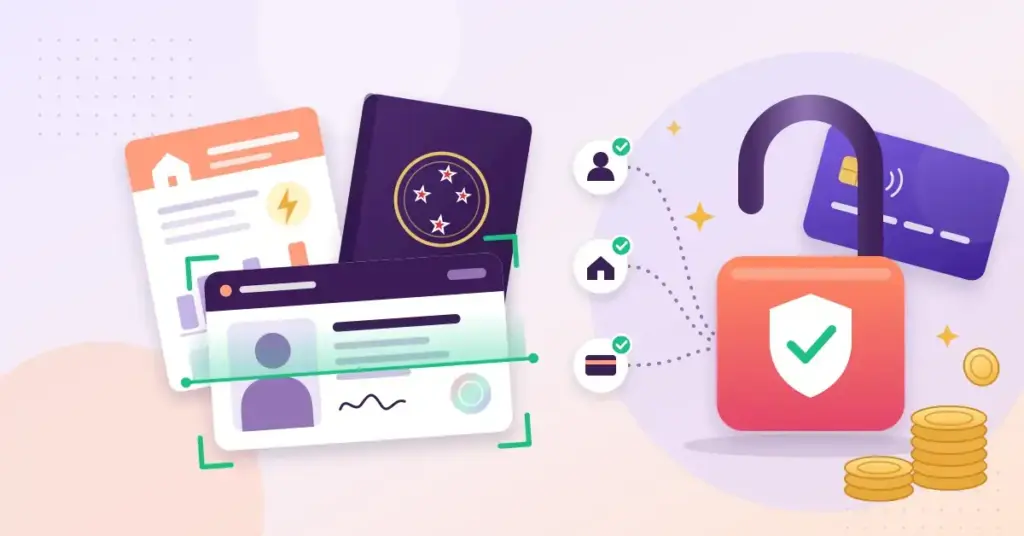
Casino account verification, usually called KYC (“Know Your Customer”), is the process where an online casino confirms you are who you say you are before it lets you withdraw money. In New Zealand the standard set of documents is proof of identity (a passport or driver licence), proof of address (a recent utility bill or bank statement) and proof of payment (the card or e-wallet you deposited with). Casinos ask for these because anti-money-laundering law requires it, not because they are being awkward. This page explains what you will be asked for, how long it takes and why — it is background information for people researching the topic, not a recommendation to sign up with any operator.
Key Points
- KYC (Know Your Customer) is the identity check an online casino runs before it lets you withdraw money.
- The standard set is proof of identity (passport or driver licence), proof of address (a recent bill or statement, usually from within the last three months) and proof of payment; some casinos add a selfie or video check.
- Verification times vary by operator — from almost instant with automated checks to a few working days when a person reviews your documents — and the check is most often triggered by your first withdrawal request.
- Casinos verify you mainly to meet anti-money-laundering law, confirm your age, prevent fraud and make responsible-gambling tools work.
- Uploading ID is safe with a licensed operator; “no-verification” crypto casinos usually still demand KYC when a withdrawal looks unusual.
- Under the Anti-Money Laundering and Countering Financing of Terrorism Act 2009, casinos must carry out customer due diligence, so KYC checks apply to online casinos serving New Zealanders.
What is casino account verification (KYC)?
KYC is the identity check a regulated gambling operator runs on every customer. The term comes from financial regulation: before a bank, casino or payment service lets you move money, it has to “know” who the customer actually is. In practice that means matching the name, date of birth and address on your account to real documents, and confirming you are the person using the account.
You will also see the phrase customer due diligence (CDD). CDD is the formal name for the baseline identity check — verifying who you are and monitoring your activity so anything unusual can be flagged. For higher-risk customers or larger sums, operators run enhanced due diligence (EDD), which adds deeper checks such as confirming your source of funds (where the money you are gambling with came from). All of this sits under anti-money-laundering rules, explained further down.
What ID and documents you need
Most online casinos ask for three things: proof of identity, proof of address and proof of payment. Some add a selfie or short video check. The exact list varies by operator and by how much you deposit or withdraw, but the core documents below are near-universal.
Documents at a glance
| Document | What it proves | Accepted examples | Recency rule |
|---|---|---|---|
| Proof of identity | Who you are, your age | Passport, driver licence | Must be current (not expired) |
| Proof of address | Where you live | Utility bill, bank statement, rates notice | Usually recent, often within the last three months |
| Proof of payment | The deposit method is yours | Masked card photo, e-wallet screenshot | Must match your account name |
| Selfie / liveness check | A real person, and that it is you | Selfie or short video vs ID photo | On request, often for larger sums |
Proof of identity
A current, government-issued photo ID proves who you are. The two documents casinos accept most often are a passport and a driver licence. The photo must be readable, the document must be in date, and the full page or both sides are usually required. The name and date of birth must match what you entered when you registered.
Proof of address
A proof-of-address document confirms where you live. A recent utility bill (power, water, internet), a bank statement or a council rates notice is typical. Most operators ask for a recent document — often one dated within the last three months, depending on the operator — showing your name and full address exactly as they appear on your account. Screenshots are often rejected; a full PDF or clear photo of the whole document works better.
Proof of payment
Proof of payment ties the deposit method to you. For a card, that is usually a photo showing your name and the first and last digits, with the middle numbers and the CVV hidden. For an e-wallet, a screenshot of the account showing your name is enough. This step stops someone funding an account with a card that is not theirs.
Selfie and liveness checks
Some casinos add a biometric step — a selfie, or a short “liveness” video, compared against your ID photo to confirm a real person is present and that it is you. You may be asked to hold your ID next to your face. These checks are more common for larger withdrawals or when an automated check cannot confirm the match on its own.
Why casinos verify your identity
Casinos verify identity mainly because the law obliges them to, but the checks serve several purposes at once:
- Anti-money-laundering compliance. Gambling is a known channel for laundering money, so operators must confirm identity, monitor activity and report anything suspicious. In New Zealand these duties come from the Anti-Money Laundering and Countering Financing of Terrorism Act 2009.
- Age and eligibility. Verification confirms the account holder is an adult of legal gambling age and is allowed to play from where they are located.
- Fraud and account protection. Matching the ID, address and payment method together makes it far harder for someone to open an account in your name or cash out using a stolen card.
- Responsible gambling. A verified identity is what makes self-exclusion and deposit limits actually work — a person who has excluded themselves cannot simply open a fresh account under the same name.
- Preventing bonus abuse. Verification stops one person opening multiple accounts to claim the same promotion repeatedly, which is one reason casinos attach wagering requirements and identity checks to bonuses.
How long does casino verification take?
Verification times vary from one operator to another. When documents are clear and current and the casino uses automated checks, approval can be almost instant. When a human reviewer has to look at your documents, or something is unclear, it can take longer — sometimes a few working days. Operators known for fast, clean processing tend also to be the ones that handle the fastest payout online casino NZ requests, because verification is the step that gates every first withdrawal.
Many casinos let you register and even deposit without verifying straight away, then require full KYC before your first withdrawal. Completing verification early — rather than when you are waiting on a payout — is the simplest way to avoid delays. For a fuller walkthrough of the cash-out side, see our guide to casino withdrawal methods in New Zealand.
Common mistakes that delay or fail verification
Most verification problems come from mismatched or poor-quality documents rather than anything suspicious. The frequent causes of delay or rejection are:
- Name mismatches. The name on your ID, your proof of address and your casino account must all match. A maiden name, a missing middle name or a nickname can hold things up.
- Out-of-date documents. An expired passport or licence, or a proof-of-address document that is no longer recent, is usually rejected.
- Poor image quality. Blurry photos, glare, cropped edges or a finger over part of the document are among the most common reasons a check fails.
- Payment-method mismatch. Depositing with one person’s card and trying to withdraw to another account will almost always trigger extra checks.
- Address that does not match. If the account address differs from the proof-of-address document, the check will stall until it is corrected.
- Using a VPN or someone else’s account. Masking your location, or playing on an account registered to another person, breaches the terms and can void both the verification and any winnings.
Is KYC verification safe?
Uploading identity documents to a properly licensed and regulated casino is generally safe, but the safety depends entirely on who you are sending them to. Under New Zealand’s Privacy Act 2020, any organisation that holds your personal information must protect it with security safeguards that are reasonable in the circumstances, and a reputable operator will use it only for compliance and limit who can access it. Documents are normally uploaded through an encrypted connection to a dedicated verification section, not emailed.
The real risk is sending documents to an unlicensed or poorly run site, where there is no regulator standing behind how your data is handled. Before uploading anything, it is worth checking the operator’s licence and data-handling policy; our overview of whether online casinos are safe covers the signs to look for. As a rule, only ever send ID to a site you have reason to trust, and never to one that asks for documents by email or over chat.
What is a “no-verification” casino?
A “no-verification” or “no-KYC” casino is one that advertises play without an upfront identity check, usually by dealing only in cryptocurrency. The pitch is speed and privacy: deposit and withdraw in crypto without uploading documents. In reality the KYC requirement rarely disappears entirely — most such sites still reserve the right to demand full verification at any point, typically the moment a withdrawal looks unusual or large, and funds can be frozen until you comply.
These sites also tend to hold lighter licences, so the consumer protections are weaker. Even a well-known crypto brand such as BitStarz applies KYC when its risk checks are triggered, which shows that “no verification” is usually better read as “no verification until something prompts it.” A genuinely anonymous, no-KYC casino is incompatible with a licensed New Zealand operation, because the anti-money-laundering obligations described below require customer identification.
KYC and the New Zealand legal picture in 2026
In New Zealand, casino KYC is driven by two separate laws. The first is the New Zealand Gambling Act 2003 framework and the long-standing Anti-Money Laundering and Countering Financing of Terrorism Act 2009, under which the Department of Internal Affairs (DIA) supervises casinos and requires them to run a risk assessment, operate an AML/CFT programme and verify customers. The second is the new Online Casino Gambling Act 2026, which for the first time creates a domestic licensing regime for online casinos.
The Online Casino Gambling Act 2026 came into force on 1 May 2026 and applies to any operator enabling online casino play from New Zealand, wherever that operator is based. The DIA can grant a maximum of 15 licences, each covering a single brand, with no single applicant allowed more than three. The licences are not handed out directly: a competitive auction awards the right to apply for a licence, and the successful bidders then go through a formal licence application and a suitability assessment before any licence is granted. Expressions of interest ran from mid-July to 14 August 2026, with the auction expected in September 2026 and licence applications opening the following month. Operators that have not applied must stop offering online casino gambling to New Zealanders from 1 December 2026, and a fully licensed regime is expected to be operating in 2027.
Two points matter for players. First, advertising of unlicensed online casino gambling to New Zealanders has been prohibited since 1 May 2026, which is why reputable New Zealand sites do not publish ranked “best casino” or bonus lists for offshore operators. Second, the anti-money-laundering duties under the Anti-Money Laundering and Countering Financing of Terrorism Act 2009 continue to apply to casinos supervised by the DIA, so operators serving New Zealanders must carry out customer due diligence — meaning the documents described above remain a standard part of using an online casino. The oversight role sits with the DIA and, for wider gambling-harm and integrity matters, the NZ Gambling Commission.
Responsible gambling
This article is background information about identity verification, not advice to gamble or a recommendation of any operator. Verification does not change your odds of winning, and no document, bonus or “system” improves them. Gambling should only ever involve money you can afford to lose. If gambling is causing harm to you or someone you know, free, confidential help is available in New Zealand 24/7 from the Gambling Helpline Aotearoa on 0800 654 655 or by texting 8006, and support and self-help tools are available through Safer Gambling Aotearoa. You can read more about staying in control in our guide to responsible gambling in New Zealand.
Sources
- Department of Internal Affairs — AML/CFT: Financial Institutions and Casinos
- Department of Internal Affairs — AML/CFT: Information for the public
- GamingTechLaw — New Zealand Online Casino Licensing 2026: Requirements, Deadlines and How to Apply
- Office of the Privacy Commissioner — Privacy Principle 5: Storage and security of information (Privacy Act 2020)
- Community Law Aotearoa — Credit reports
- Safer Gambling Aotearoa (Health New Zealand – Te Whatu Ora)
- Gambling Helpline Aotearoa
Frequently asked questions
Do I have to verify my identity at every online casino I use?
Yes. KYC is tied to the individual operator and its own regulatory obligations, so verifying your identity at one casino does not carry over to another. Each site you open an account with will run its own check, usually before it lets you make your first withdrawal.
Can I withdraw winnings before my account is verified?
Generally no. Verification is the step that releases your first payout, so a withdrawal request is often what triggers the KYC check. Completing verification soon after you register, rather than waiting until you want to cash out, is the quickest way to get paid without a hold.
What happens if my KYC documents are rejected?
The casino will normally tell you why and ask you to resubmit. The usual fixes are a clearer photo, an in-date document, or a proof of address that matches the name and address on your account. Your funds are not lost while this is resolved, but withdrawals stay on hold until the check passes.
Does casino KYC show up on my credit report?
No. Casino identity verification is not a credit or loan application; it confirms who you are, your age and your address, not your creditworthiness. Some operators check your details electronically against identity and credit-reference data, but any such check is a soft identity check rather than an application for credit. In New Zealand it is credit applications and missed payments — not an identity check — that affect your credit rating, so verifying a casino account should not change your credit score.